Kadmo-hosted agents, self-hosted agents and Kadmo Git
Run an agent on a Kadmo machine, billed by the hour, or on your own. Every new workspace gets a git repository, and your AI providers and limits a page each.
On this page 6 sections
In short
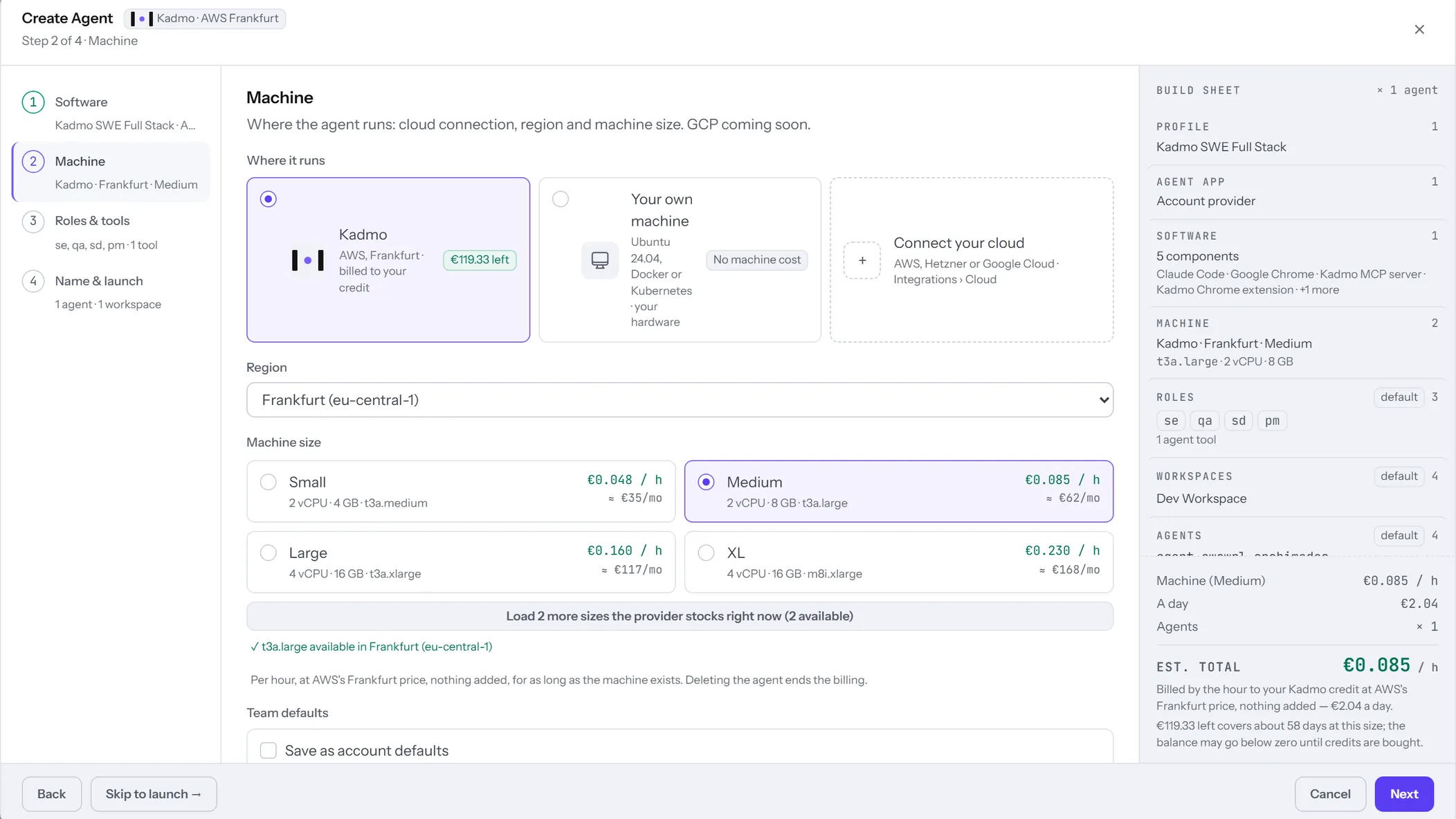
- Kadmo-hosted agents: a new agent runs on a Kadmo machine in Frankfurt, billed by the hour at the price AWS charges, from the same credit your models spend.
- Your own machine: run an agent on Ubuntu 24.04, in Docker or on Kubernetes, for free; it connects out to Kadmo and needs no inbound port.
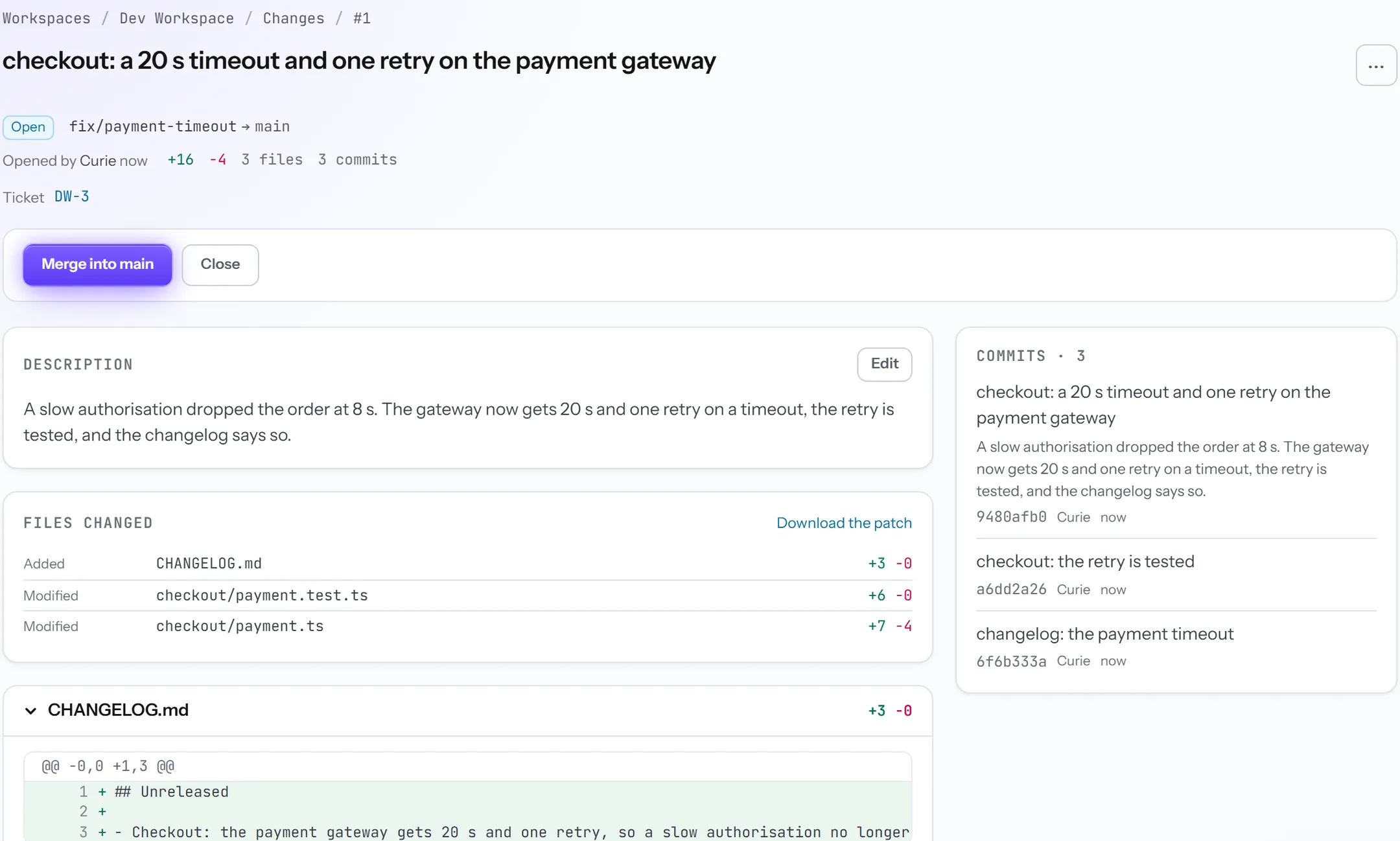
- Kadmo Git: every workspace is born with its own git repository on Kadmo, and a pushed branch opens a change request you merge in Kadmo.
- BYOK and Guardrails, two pages for your providers and your limits; and Goals, Ask and the rest of the app on for every account.
The third release put your voice and your files in the chat. This one is about where an agent runs and where its work lives: a Kadmo machine by the hour, a machine of your own, and a git repository for every new workspace. Your AI providers and your limits each got a page as well. The app’s part reaches every account at once; an agent created before 22 October joins Kadmo Git after its next Self Update.
An agent on a Kadmo machine
Create Agent now offers Kadmo as the first place an agent can run: a machine on AWS in Frankfurt, billed to your credit. It is picked for you when no cloud is connected. Each size shows its price an hour, in euros, at AWS’s own price, and the build sheet says how many days your credit covers at that size. The agent is online about ten minutes after Launch.
The machine is paid by the hour from your Kadmo credit, the same credit your models spend: the machine, its disk and its public address at AWS’s price, nothing added. The agent’s page shows the price an hour, a day and a month, and the hours billed so far. Stop powers the machine off and bills the disk alone; Destroy ends the billing. Settings › Billing has a Hosted agents line.
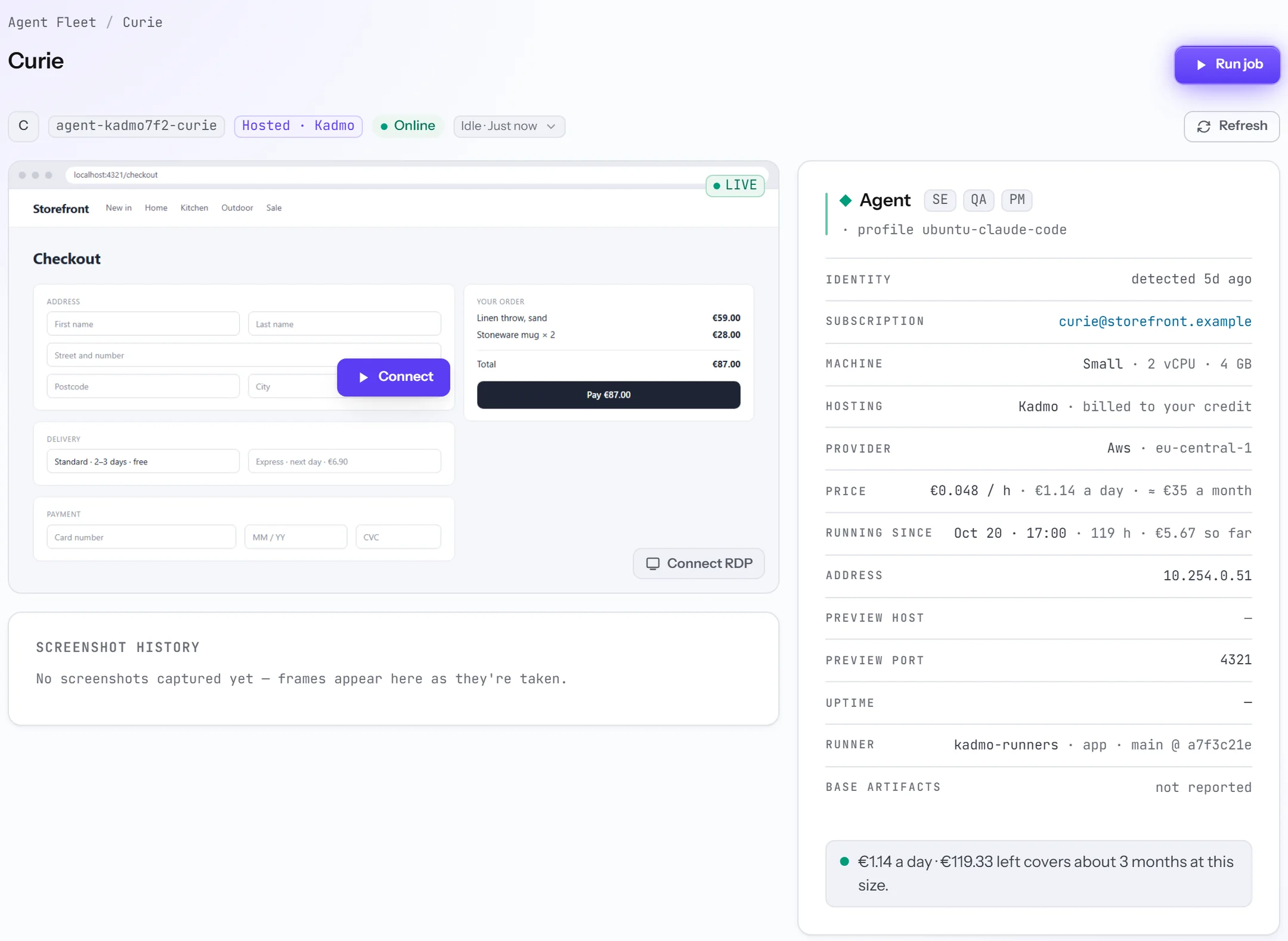
On a plan, nothing stops a machine when the credit runs out: it keeps running, and the balance may go below zero until credits are bought. A trial’s balance never goes below €0: its machine stops at €0 and when the trial ends, its disk kept. Your plan decides which sizes Kadmo hosts and how many agents at a time; a trial hosts one Small agent.
An agent on your own machine
Where it runs has a third choice, Your own machine, and it is free: Ubuntu 24.04, a host that runs Docker, or a Kubernetes cluster, with 2 vCPU, 8 GB of memory and 40 GB of disk per agent. Launch gives each agent a single-use token, good for 60 minutes, and three commands with the token filled in: Ubuntu, Docker with the image kadmoai/kadmo-agent, and Kubernetes with the Helm chart kadmo-agent-chart. Run one on the machine. About half an hour later the agent reports Online.
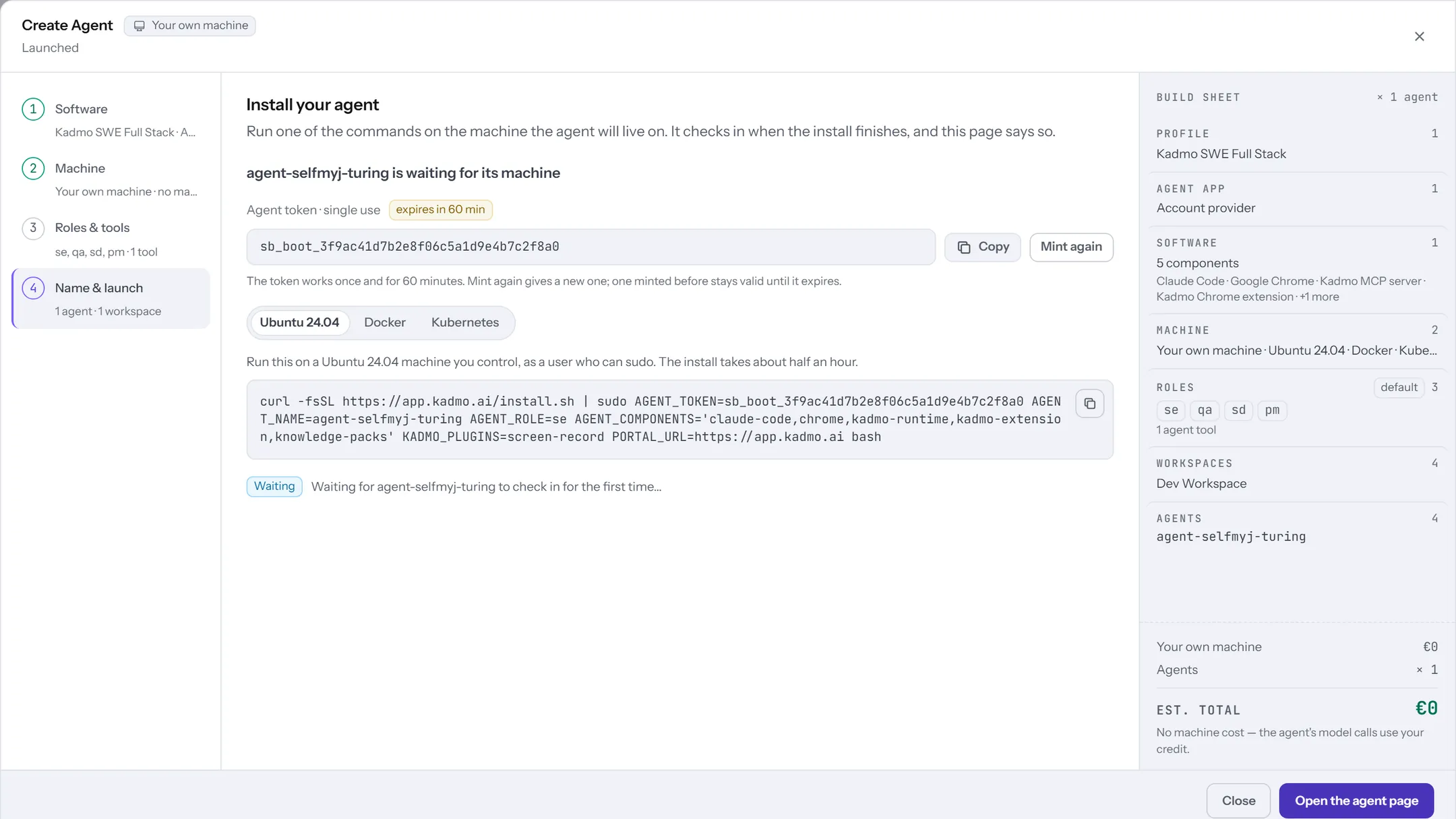
Your machine needs no open port and no VPN. The agent keeps one connection open to the app, the agent channel, and the app sends jobs, health checks and the live desktop down it. The install brings the profile’s components and the Kadmo Agent Runtime, and Re-install on another machine moves an agent. An agent that never checks in is archived after seven days.
Kadmo Git: a repository for every new workspace
Every workspace created since 22 October is born with its own git repository on Kadmo, at https://git.kadmo.ai/<account>/<workspace>.git, attached as its first git project; so is a new account’s Dev Workspace. Agents clone and push it with a credential Kadmo delivers to them; you reach it with a personal git token from Integrations › Kadmo Git, shown once. The main branch refuses a force-push and a deletion, and a repository holds up to 1 GB.
Change requests follow git itself, so agents work on Kadmo Git as they do on GitHub. A pushed branch opens a change into main, and the push’s output prints its number and its page. Further pushes move it along, its commits landing on main merge it, and deleting the branch closes it. The change’s page shows the commits and the diff, links the job, the run and the ticket, and any member can merge or close it there.
Integrations now leads with two cards that are connected from the start: Kadmo Git and Kadmo Issue Tracking. The second stands for your internal tasks, tickets Kadmo keeps itself. Both work beside Jira, Linear or Notion.
BYOK and Guardrails
Your AI providers have a page of their own. BYOK lists them as rows, and the one that serves is lit: Kadmo serves, with the credit left, or Your key serves once your own Anthropic, OpenAI or OpenRouter key does. Its second tab holds the agent apps.
Guardrails, right after it, holds every limit on your model calls in five panels. Budgets, for the account and per workspace, are set here. Data residency picks the regions your models may run in, EU, US or Global, per account and per workspace; a call outside them is refused with the reason and the fix. Models shows the default and how many are switched on, and a switched-off model is refused on every lane. Call rate shows the ceilings in force.
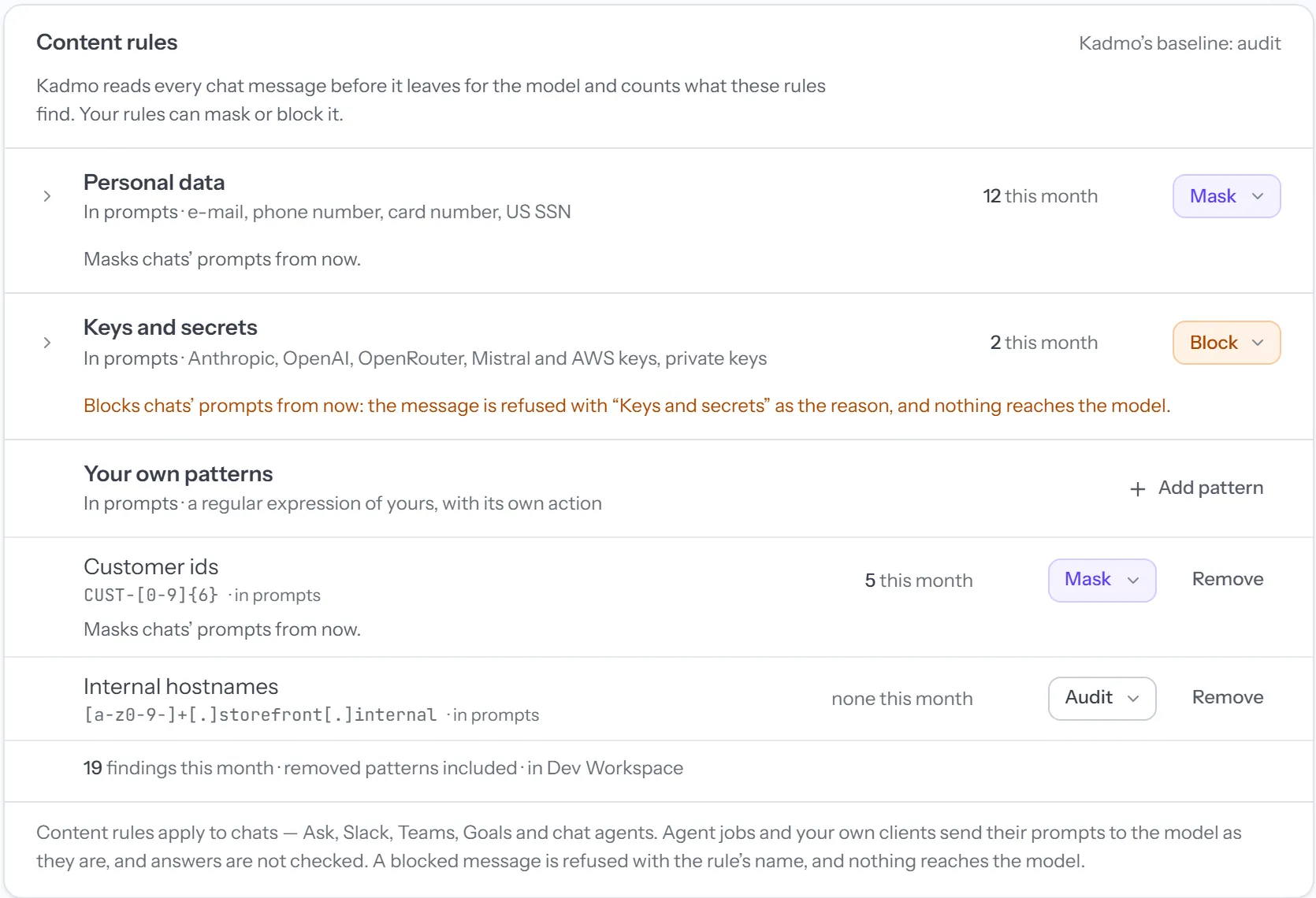
Content rules are new. Kadmo reads every chat message before it leaves for the model and finds personal data, keys and secrets, and up to 25 patterns of your own. Each can be audited, masked or blocked. Block refuses the message with the rule’s name, nothing reaches the model, and the message is not charged. Your agents’ jobs and your own clients are not read. Data residency and content rules come with Business and up.
BYOK in the docs · Guardrails in the docs
Goals and Ask for every account
The Experimental features switch is gone. Goals, Ask Kadmo with its ⌘K box, bulk actions on Tasks and the live review suggestions are on for every account.
You are always in a workspace. The switcher no longer offers All workspaces: the first sign-in opens your account’s first workspace, and every page and count shows the one you are in.
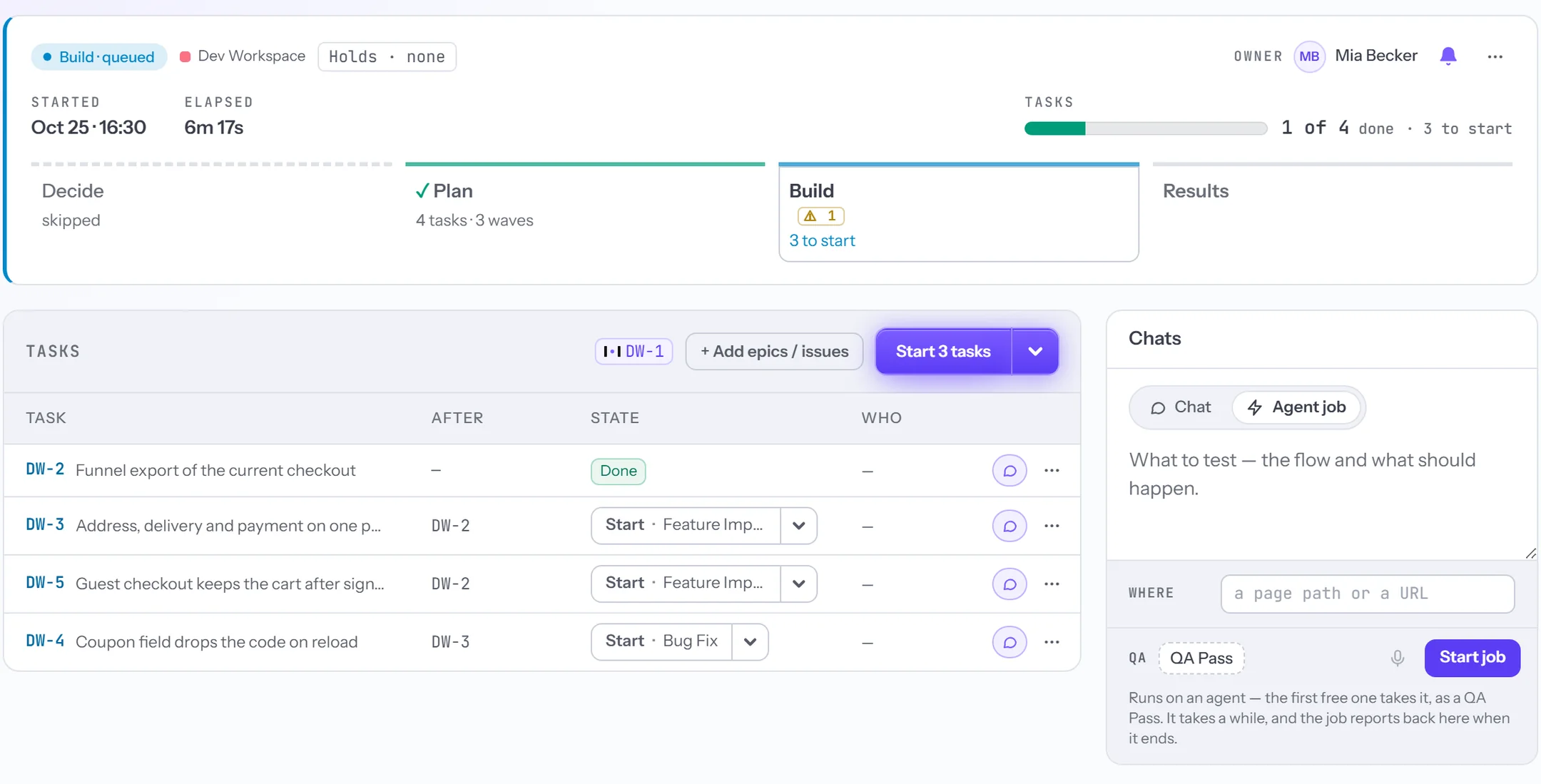
A goal’s task starts from its row. Start · ‹playbook› adds it to Tasks and approves it in one press; the arrow beside it picks another playbook or adds the task for approval only. The epic’s head does the same for every task that can start. The analysis of an epic now knows its goal and your house rules, and a question already answered on the epic comes back as Answered.
Also in this release
Action needed
- Sign-in: on 24 October, app.kadmo.ai moved to Kadmo’s own sign-in service. If you sign in with an e-mail address and a password, choose Forgot password once at your next sign-in; a password does not move between services. Sign-in with Google carries on as before.
- Agents: run Self Update on an agent created before 22 October. It brings the Kadmo Agent Runtime 0.5.0, which clones the workspace’s Kadmo Git repository.
Improved
- The app, the docs and kadmo.ai share one refreshed light theme, Kadmo Light 0.7.0.
- An agent’s secrets stay with its owner: its token, passwords and environment are returned to no one, and an account that borrows a shared agent can no longer reboot, stop or destroy it.
- A Google sign-in with the same verified address joins the existing member, and a member can hold several logins.
- On the fleet, Ctrl-click or ⌘-click marks agents, and one Add component button serves the marked ones.
- A goal’s tasks are one list, in the order they can start, with an After column; done tasks fold under one row.
- The Workflows list reads at every width, the Tasks page folds its intake while work runs, and Goals comes before Tasks in the sidebar.
- A task waiting for you reads Needs approval, and Start replaces Dispatch everywhere.
- The GitHub dialog leads with the GitHub App, and the token is optional.
- The Request Hosted Agent door is gone from the wizard; an agent Kadmo lends your account reads Shared · Kadmo.
Fixed
- A finished Self Update frees the agent at once instead of after a 15-minute window, and a pause put back after a session hold keeps the agent paused.
- An account Kadmo’s team creates for you starts complete, with its first workspace and its own copies of the default playbooks.
- Dispatch Now with no agent named stays inside the row’s workspace, and detaching an agent from its last workspace no longer undoes itself.