Platform Models and keys
Models and keys
Chats, automations and agent jobs can all reach their models through Kadmo, paid from one credit. You decide which model does which work, you can bring keys of your own where your plan includes them, and your team’s own clients reach the same gateway through one AI API.

On this page 7 sections
How a call reaches a model
While Kadmo is your provider, every feature takes the same road. Ask Kadmo, Slack, Microsoft Teams, Goals, automations that decide on a request, chat agents and agent jobs all call Kadmo’s gateway at llm.kadmo.ai, and the cost comes out of your Kadmo credit.
Before each call the gateway asks the app whether it may run. The app checks the model’s region against what you allow, that your plan includes the model and that it is switched on, and that your credit and budgets leave room. With no answer from the app, nothing goes out.
That gateway serves two makers today: Anthropic’s Claude and OpenAI’s GPT, both from the US. Settings › Models also lists models Kadmo does not serve yet, marked as such: they stay out of every picker. Which models your plan includes is on the pricing page.
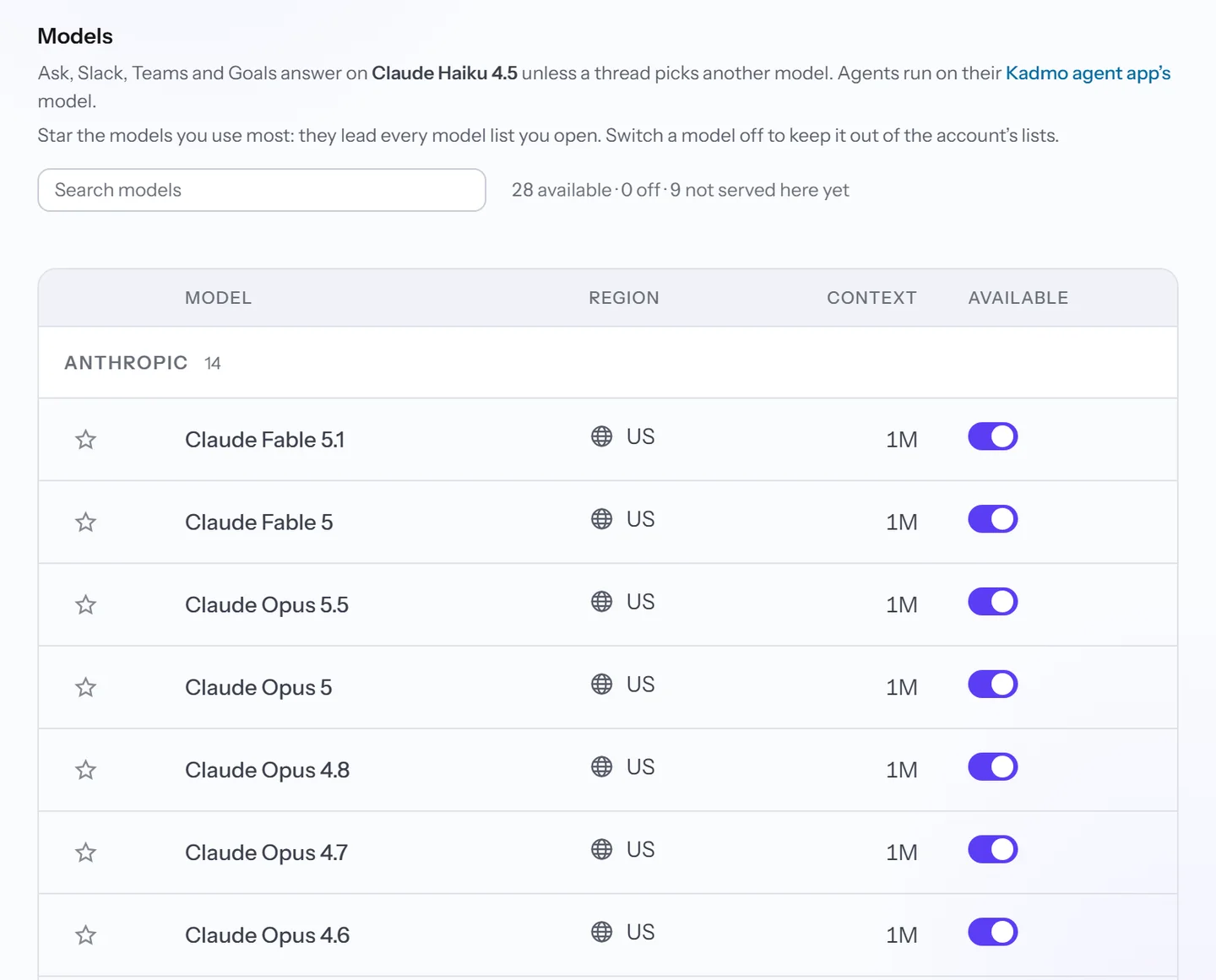
Chats answer on the account’s default model, which an admin sets here, and a thread can pick another. Agents take theirs from their agent app, which the next section explains.
A model per step
A small check and a hard plan do not need the same model. Two settings decide what a step runs on:
| Setting | Where you set it | What it decides |
|---|---|---|
| Agent app | On an agent, on the workflow behind a step, or for a single run | The coding app, the provider and, where it names one, the model |
| Effort tier | On a step, a playbook, a workflow or a single run | How hard Claude Code works, and the model where the agent app names none |
An agent app on your Kadmo credit always names a model. So a step there gets its own model through its workflow’s agent app, and its tier sets how hard that model works. On your own Claude subscription the app names no model, so the tier picks both. A step with no tier inherits one from its playbook, then its workflow, then the account, and a tier chosen for one run beats them all.
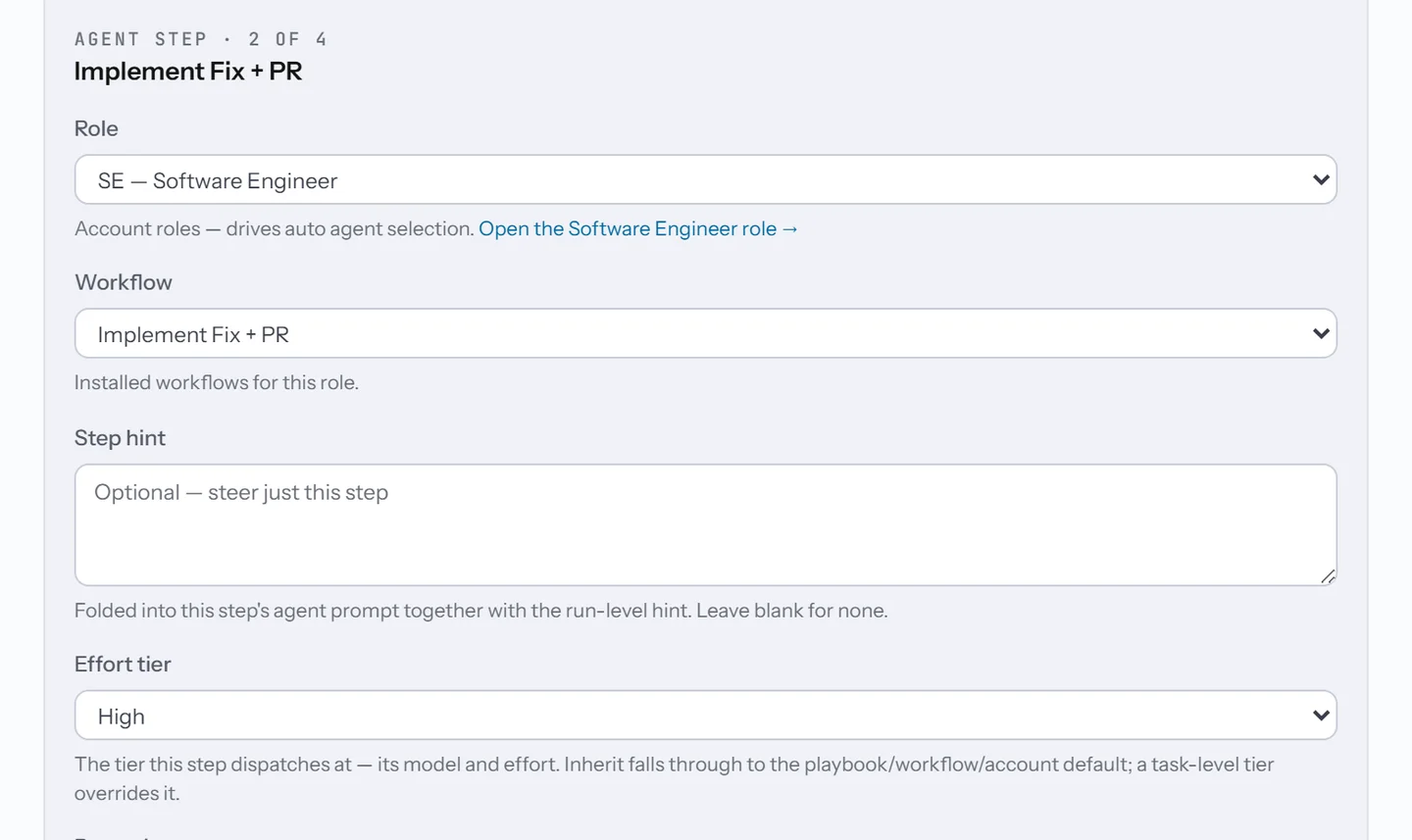
Tiers belong to your account, and admins rename, reorder and add them. Your playbooks name a tier, never a model, and that is what no lock in means here: moving to a better model is a change to an agent app, or to a tier where the app names none, and no playbook has to change with it.
Your own keys
Where your plan includes them, an admin connects a key of your own on the BYOK page, for Anthropic, OpenAI or OpenRouter, or the address of an OpenAI-compatible endpoint. One connection serves the account at a time. Your provider bills those calls, so they leave your Kadmo credit alone.
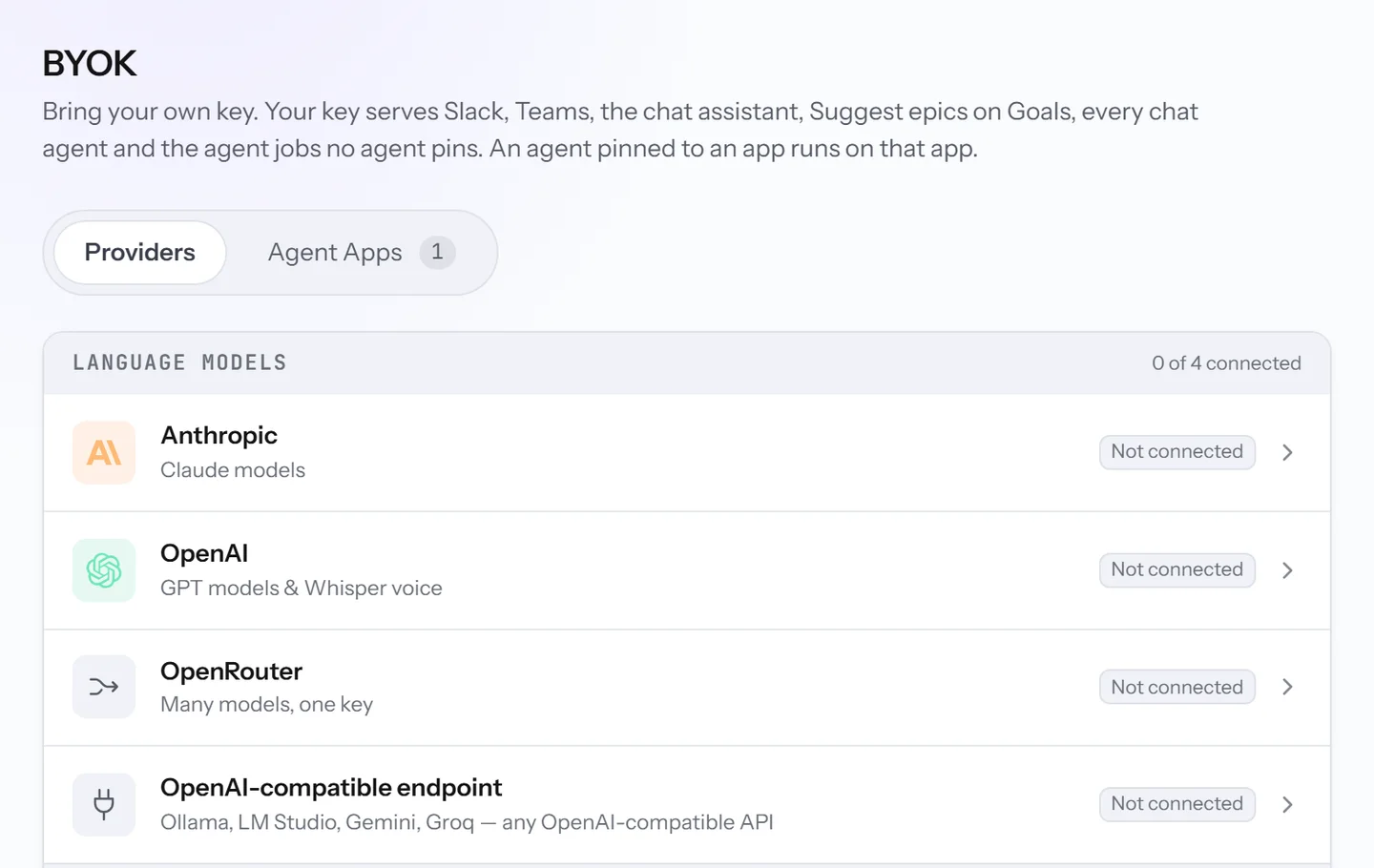
With no key connected, Kadmo answers. With a key connected, it serves your chats, your chat agents and every agent job without an app of its own, and if it fails, the call is refused and nothing moves to your credit. An OpenAI-compatible endpoint serves only the app’s own features, not agent jobs. Disconnect, and the account is back on Kadmo.
The same plan opens direct agent apps: Claude Code on your own Claude subscription, an API key, a gateway of yours, Bedrock, Vertex or Foundry, or Claude Code with its router on OpenAI, Gemini or an endpoint of your own.
The LLM API
Your team’s own clients can use the same gateway. Kadmo’s LLM API is an AI API in Anthropic’s Messages format, so Claude Code on a laptop or a script on an Anthropic SDK only has to point somewhere else:
export ANTHROPIC_BASE_URL=https://llm.kadmo.ai
export ANTHROPIC_AUTH_TOKEN=kadmo_pat_your-token
The token is a member’s personal token, or the sign-in of a connected client, and it is all the API needs to find your account. A call runs within your plan’s models, your account’s regions and budget and the models switched on. It is paid from your Kadmo credit, even where your own key serves everything else.
Questions
Which models run on Kadmo today?
Anthropic’s Claude and OpenAI’s GPT models, both served from the US. The app also lists models Kadmo does not serve yet, marked as such, and no plan unlocks them.
What happens if our own key stops working?
The call is refused. Kadmo does not quietly answer in its place, so a broken key never turns into a charge on your credit.
Does a better model mean rewriting our playbooks?
No. A playbook names an effort tier and never a model, so you change an agent app, or a tier’s model where the app names none, and the playbooks stay as they are.
Set it up
The models and credit guide covers what your plan decides, the BYOK page, your own keys and the LLM API. The agents guide explains agent apps and effort tiers.
-
Guardrails
Budgets with a ceiling, the regions and models you allow, and rules for what chats may send.
-
AI coding agents
Agents in the roles you define, each on its own machine, on Kadmo or on yours.
-
Playbooks
The steps for each kind of ticket, each with a role, and a gate at every handoff.