Skip to content

An OpenAI alternative with the right model for each step.

A quick classification, an implementation plan and a final review ask different things of a model. Kadmo lets your software team choose supported models from OpenAI, Anthropic and its other configured providers for the work each step must do.

Keep the workflow, assess the result and change a model assignment when another option serves the task better. Kadmo brings that choice to its chats, agents and supported external clients through an Anthropic Messages API.

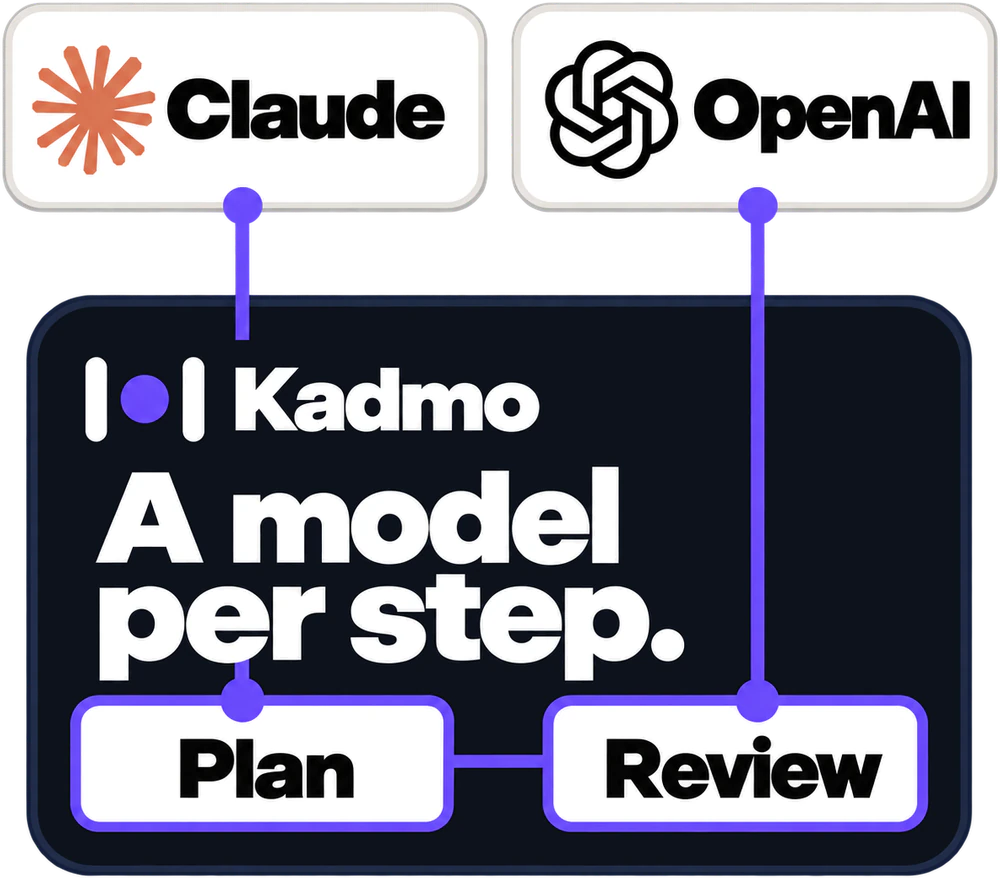
Two tiles, Claude and OpenAI, connect by violet lines to a dark Kadmo card, A model per step: Claude to the step Plan, OpenAI to the step Review.

Start with what the step must get right.

Suppose a bug-fix process begins by classifying a report, then investigates the cause, implements a change and reviews it. Classification needs a clear answer in a known format. Investigation needs enough reasoning to distinguish a cause from a symptom. Review needs to examine the change against the intended behavior.

Those requirements give you a basis for choosing models. A smaller model may cover the first step. A more capable model may earn its cost on the investigation. Judge each against the evidence the next step needs.

Put different model families in one workflow.

A Kadmo playbook can assign a model to each agent step. Planning can use Claude while another step uses GPT, with the roles, reports and acceptance conditions remaining part of the process.

Your choices come from the models available through your configured provider routes and plan. You can retain OpenAI for the work it handles well and introduce another provider where it helps, with a clear reason for each assignment.

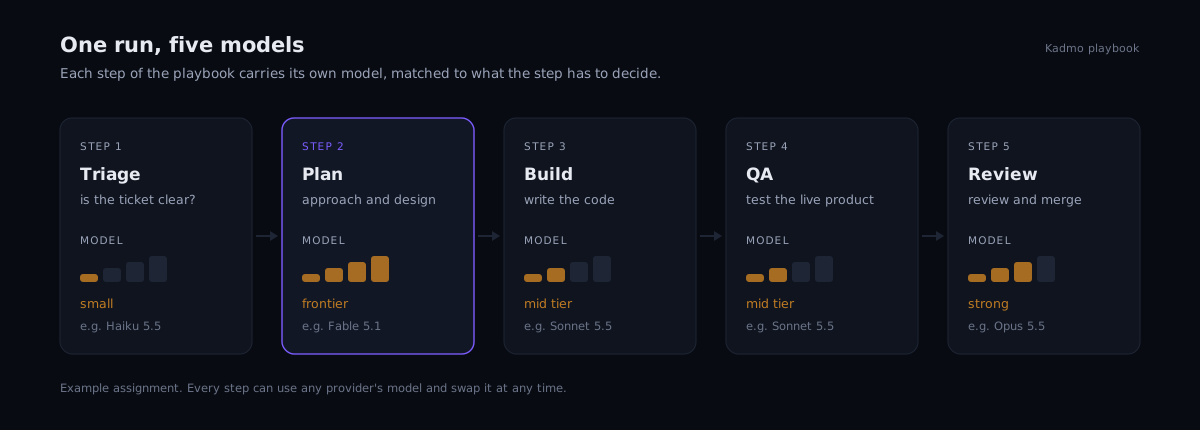
One playbook run in five steps, each carrying its own model: a small model for triage, the strongest for the plan, mid-tier models for building and QA, and a strong model for the review.

OpenAI models, with a choice of coding CLI.

Claude Code with Claude Code Router

OpenAI models · Routed coding CLI

Use OpenAI models from Claude Code through Claude Code Router. Claude Code supplies the coding environment; the router connects its model requests to OpenAI. This gives a team working with Claude Code a supported route to GPT for agent work.

Codex

OpenAI models · Supported agent CLI

Run Codex as the coding CLI on a Kadmo agent with OpenAI models. Give the agent work through Kadmo, follow its execution and inspect its result in the delivery process your team uses. Choose this setup when Codex is the coding environment you want to run.

Change an assignment, then check the result.

Try a candidate model on one bounded step before moving a whole process. Use a representative task and the same acceptance conditions. Inspect the output, the tool behavior, the time taken and the model cost.

Changing the configured model does not establish that its behavior is equivalent. You may need to adjust instructions or how a step uses tools. Kadmo keeps the process explicit so the team can assess a change against the work it must complete.

See where model spending went.

Kadmo prices model calls by their input and output usage, in euros, against its current price sheet. Billing shows spending by workspace, model and kind of work, with threads and jobs available for closer inspection.

Use that record to understand an expensive run. An investigation may justify a larger model; a repetitive check may be a candidate for a smaller one. The useful comparison is the cost of a result that meets the step’s requirements, including any rework it needed.

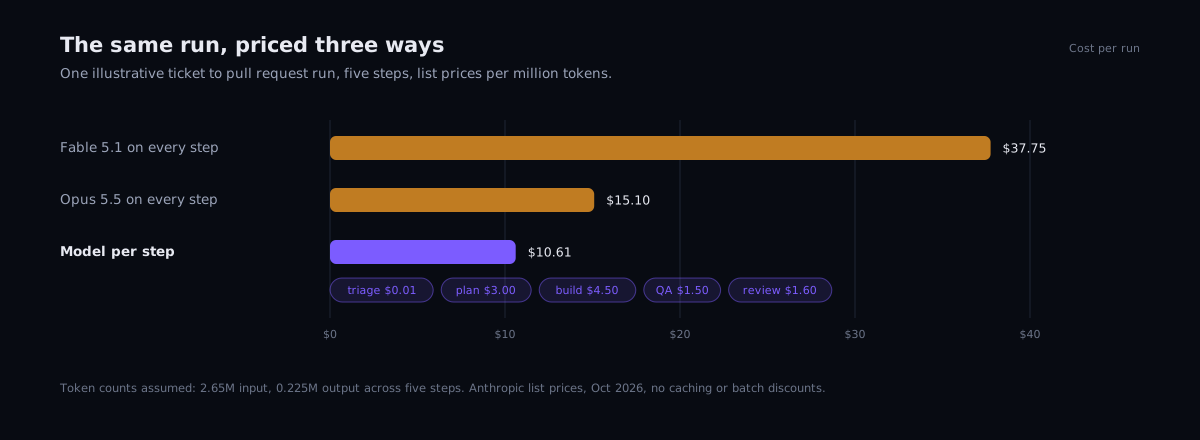
The cost of one illustrative run priced three ways: every step on the strongest model, every step on a mid-tier model, and a model chosen per step.

Set the model budget before the work starts.

For Kadmo-served calls, credit is set aside before the request runs and settled against actual usage afterwards. Agent jobs reserve their estimated model cost and pause when that reservation is exhausted.

Admins can also set monthly or total budgets for the account or a workspace. A limit gives the team a decision point: add credit, revise the budget or change the work. The refusal or pause explains what needs attention.

Account for the costs around the model.

Model credit is one part of the total. The platform plan and hosted-agent machine time are separate costs. Calls using your own provider credentials are billed by that provider; machines in your cloud are billed by your cloud provider.

A model-spend pause does not shut down a paid machine. Include its running time when assessing the cost of a workflow, and choose the hosting and provider arrangement that suits your team.

When direct OpenAI access fits better.

Use direct OpenAI access when your application depends on OpenAI-specific APIs, native features or a provider relationship you want to operate directly. Kadmo is particularly useful when the model choice sits inside a team’s engineering work and should remain changeable across providers.

Kadmo also provides an LLM API for supported external clients. It uses the Anthropic Messages format with a member’s Kadmo credentials. An application using OpenAI’s Responses or Chat Completions format needs an appropriate integration; the endpoint is not a drop-in replacement for those APIs.

When the main decision is who may receive a request at all, read about provider and data controls on the Anthropic alternative page.
Questions about models and spending.

Can we keep using GPT?

Yes. Provider independence includes retaining OpenAI models where they suit the task. Your team can introduce other supported models step by step rather than replacing every assignment together.

Can a cheaper model make a task more expensive?

Yes. More attempts, longer output or extra review can offset a lower token price. Compare the cost of reaching an acceptable result, including rework, before moving a routine step to a smaller model.

Does unused reserved model credit stay spent?

No. A reservation sets credit aside for work. Charges reflect actual usage, and unused reserved credit is released when the reservation is settled. Billing distinguishes reserved credit from the amount available to start other work.

Where do we decide which providers are permitted?

Your account’s enabled models, provider connections and applicable regional controls define the choices. The Anthropic alternative page covers those provider and data controls.

Map your first workflow to a model budget.

Bring a process your team already runs. Define what each step must produce, choose candidate models and agree the output and spending you will accept. Start with one change you can evaluate.