Platform Skill packs
Skill packs
Before a Kadmo agent touches your product, it reads what has been written down about it: its pages and states, how a role works there, which steps repeat. That is a skill pack. It stays in git as plain files, and you can write it yourself or send an agent to write it.

On this page 8 sections
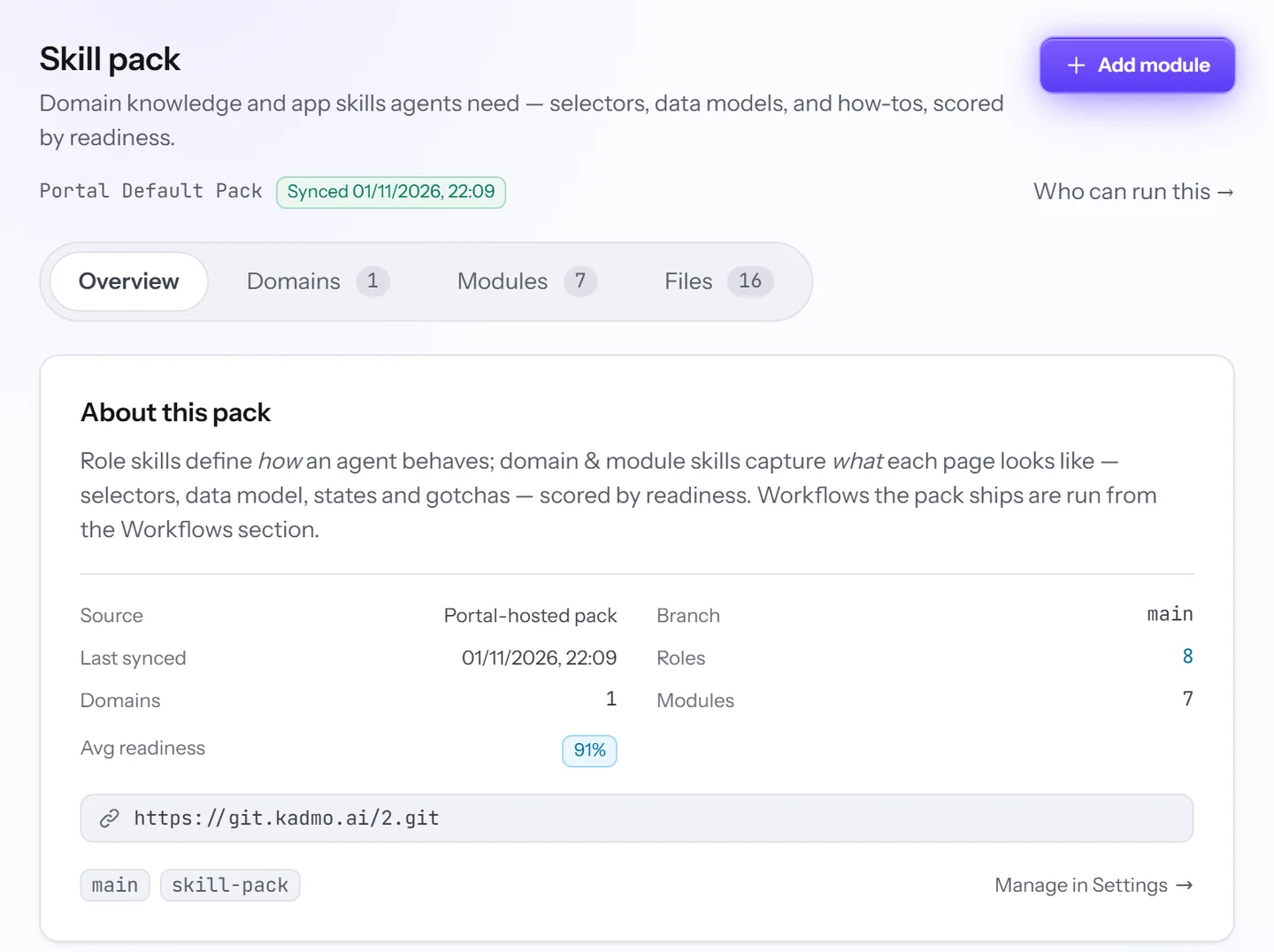
What a pack holds
A pack is Markdown and YAML in a git repository. Its top folders are domains, one per product or field of knowledge, and the folders inside a domain are modules, usually a page or an area of the product.
shop.storefront.example/
  skill-pack.json
  _skill.md
  _roles/qa.md
  checkout/
    _skill.md
    _roles/qa.md
A _skill.md holds what an agent needs there: at the top of a domain what the product is and how to sign in, in a module its selectors, data model, states and gotchas. A role guide such as _roles/qa.md says how that role works at that level, and workflows in YAML hold steps an agent or a person can run again.
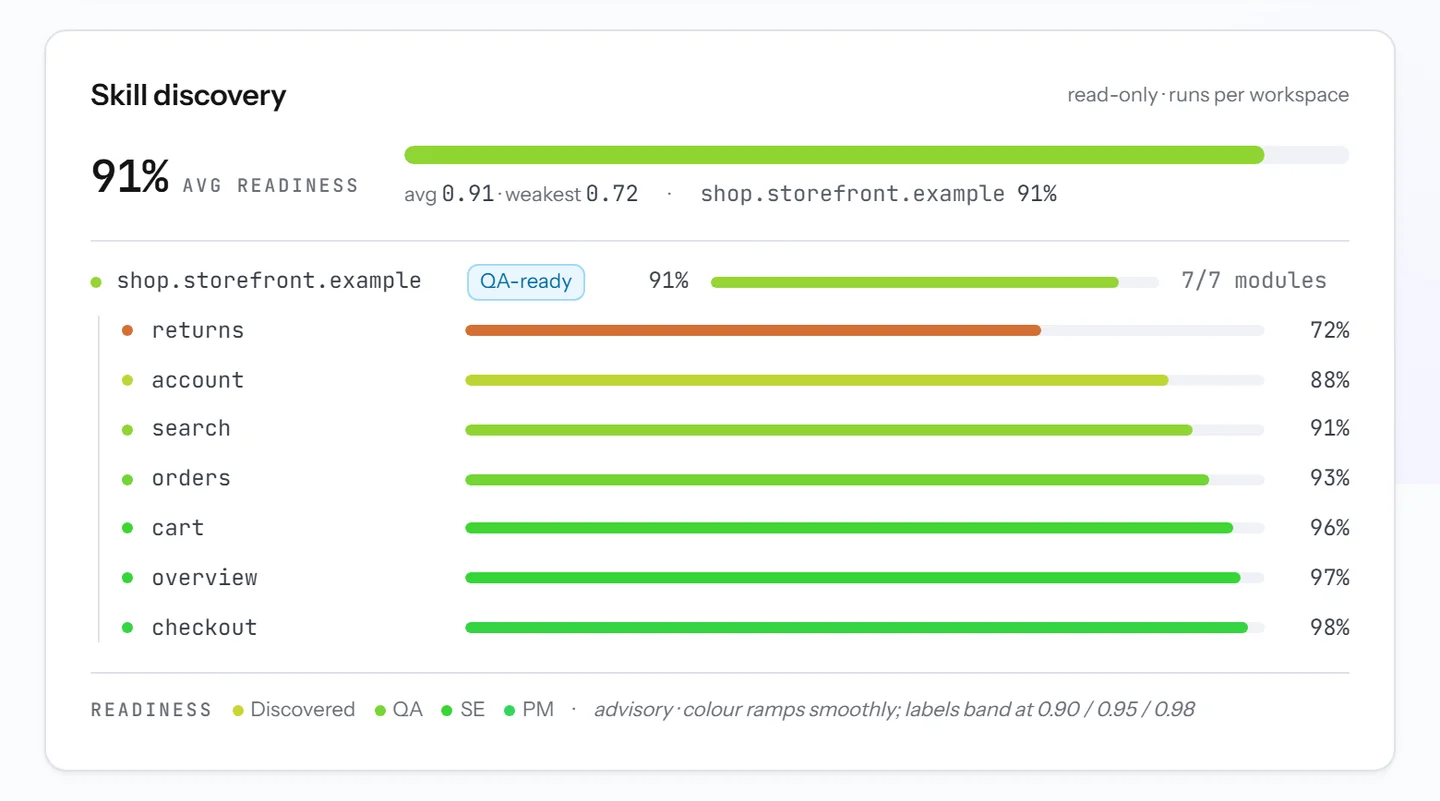
A _skill.md also declares how complete it is, and the app averages those declarations into a readiness for the domain, from Discovered through QA-ready and SE-ready to PM-ready. Readiness advises and never stops a job.
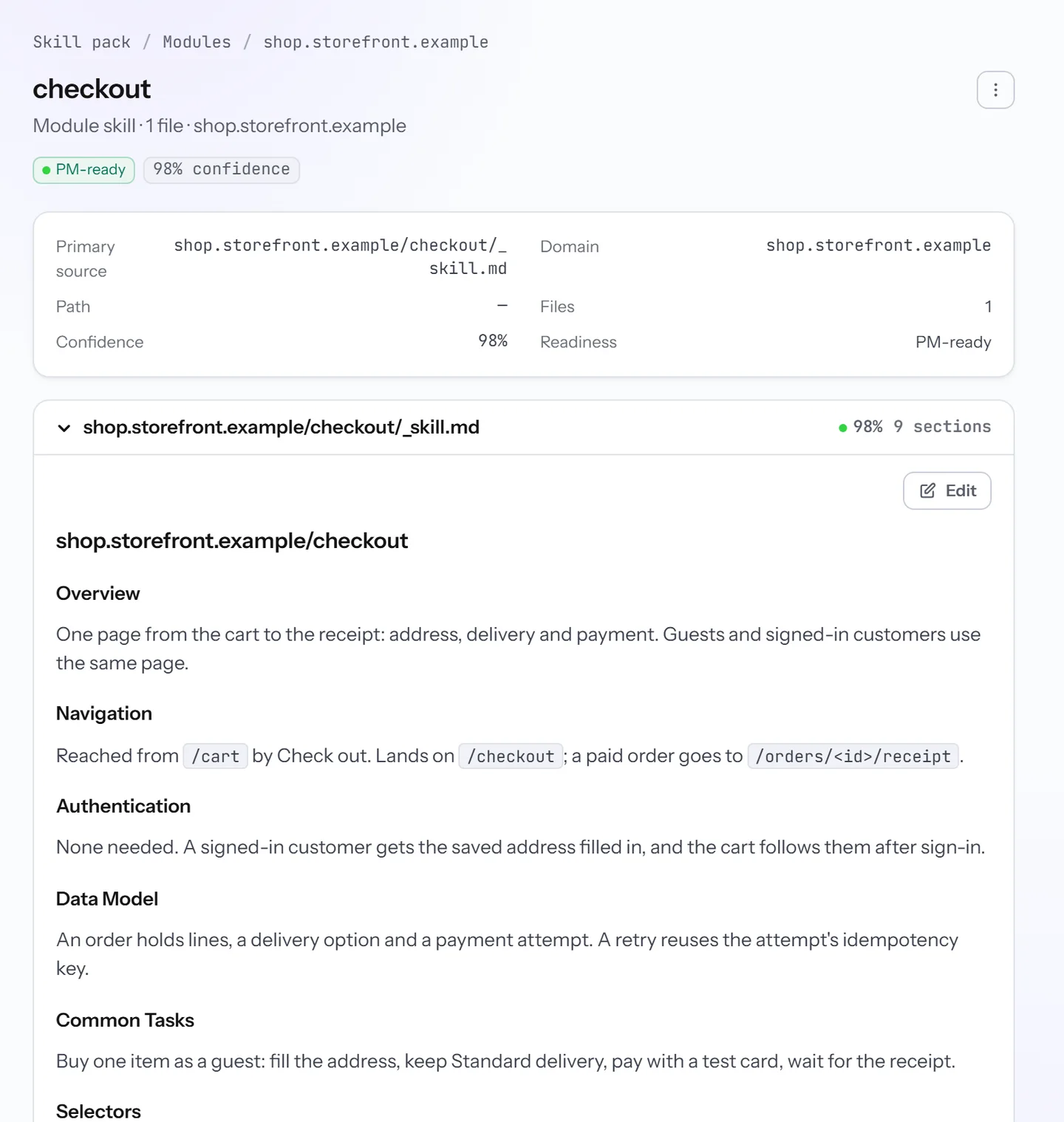
A pack belongs to the whole account, so every workspace can use every domain. Every member can read it on the Skill pack page, and an admin can edit it there, each save a commit in that admin’s name.
Four layers
Four kinds of pack exist, and each has one home:
| Layer | What it holds | Where it lives |
|---|---|---|
| The public library | Packs for well-known sites and tools, and for crafts such as writing | A public repository, open to anyone |
| Kadmo’s agent ops | The built-in role guides, the workflows playbooks start, and Skill Discovery | Private to Kadmo; the app serves them to each agent with that agent’s token |
| Kadmo’s own packs | What Kadmo knows about its own products | Kadmo’s own account, so they never reach yours |
| Your account’s pack | Your product, your roles, your workflows | A repository Kadmo hosts for you, or one of your own |
On an agent, your pack comes first. A domain is installed once, and your copy is never replaced by one from a layer below it. A role guide of yours adds to the built-in guide of that role. Edit a built-in workflow in the app and your copy goes into your pack, while the original stays as it was.
The public library
The public library is a public repository of packs under Apache-2.0, so you can read all of it before you use any of it. It covers sites and tools such as GitHub, Jira, Slack, Figma, Google Ads and Reddit, and fields such as writing, performance marketing, Elixir, GraphQL and SEPA payments with DATEV export.
Its packs are built from the same files as yours. An agent can install any of them by its domain, and your own pack of that domain still wins.
Skill Discovery
A pack can start with nothing about your product in it. Start a Skill Discovery run and one of your agents goes through the product and reads its repositories, writes what it finds into modules with a confidence for each, adds role guides where a module is well covered, and pushes the result to your pack.
One run starts from a domain’s row under Capabilities › Skills, on its weakest module or on what no module covers yet. Or turn on Auto-discovery for a workspace, and the app keeps sending runs to its free agents until they reach your target or your limit.
This is the self-learning part of Kadmo: what a discovery run writes, later jobs read, so they start from what that run found. A QA pass that finds a module stale or missing records that too, and once a person approves, it becomes a Skill Discovery task for the domain.
The role stays private to Kadmo, though you can read what your own agents run. What a run writes is yours.
How agents get updates
| What changed | When agents see it |
|---|---|
| Your pack, saved in the app or pushed to its default branch | Within about five minutes, with no version to raise |
| Kadmo’s agent ops | With a Kadmo release: each agent checks on that same round, and a step that asks for a newer version refreshes it first |
A save to that branch shows in the app at once, and so does the result of a discovery run. A change on another branch or in an open pull request reaches no agent. Your account’s Claude Code skills travel separately, through its marketplace.
Questions
How is a skill pack different from a Claude Code skill?
A pack is knowledge about your product, and the Kadmo runtime serves it to your agents. A Claude Code skill is a set of instructions installed into Claude Code itself, on agents and on your developers’ machines.
Do we have to write the first pack ourselves?
No. A Skill Discovery run goes through your product and its repositories and writes down what it finds.
Can the pack live in our own repository?
Yes, on GitHub, GitLab or Bitbucket. The app then only reads it, unless you let it commit there or, on GitHub and GitLab, open pull requests.
Can we change a pack from the public library?
Yes. Its licence lets you copy any pack into your own repository and rewrite it, and from then on your agents read your copy.
Set it up
The skill packs guide covers what a pack holds, your account’s repository and Skill Discovery. Creating skill packs has the files in detail, and Roles and personas how a pack ships a role.
-
Claude Code skills
Your account’s own marketplace: agents install it and developers connect to it.
-
AI coding agents
Agents in the roles you define, each on its own machine, on Kadmo or on yours.
-
Ask Kadmo
Answers from your account, with sources. A request for work comes back as a plan.